
Engineering Surveys provide precise spatial control, monitoring, and measurement services to support construction, infrastructure development, and asset management. Our workflows ensure accuracy, compliance, and traceability throughout the project lifecycle, from initial site establishment to final as‑built verification.
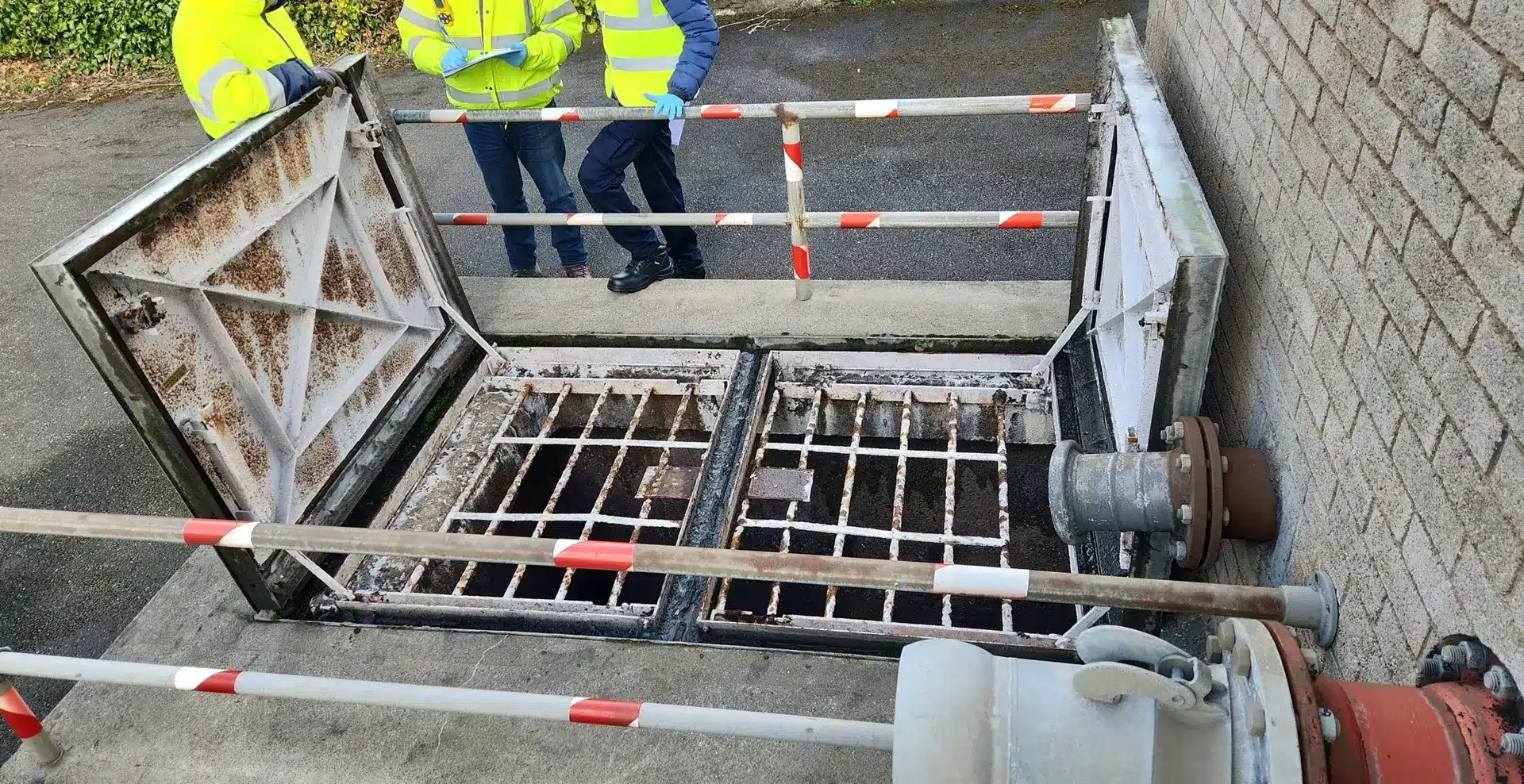
Accurate tracing and mapping of underground pipelines using a combination of advanced detection techniques. These methods help identify pipe routes, connections, defects, and flow paths to support drainage investigations, utility verification, and safe excavation planning.
Methods include:
Electromagnetic (EM) Locating Used to trace metallic pipelines and services by inducing a signal and following its path along the ground surface.
Ground Penetrating Radar (GPR) Ideal for detecting non‑metallic pipes, voids, and buried structures where EM locating is not effective.
Dye Testing Non‑toxic dye is introduced into the system to confirm connectivity, flow direction, and cross‑connections within drainage networks.
Smoke Testing (Smoke Method) Non‑toxic smoke is pushed through pipelines to visually identify manholes, leaks, illegal connections, broken pipes, missing caps, and infiltration points at the surface.
Sound Testing (Acoustic Tracing) A controlled sound source is introduced into the pipeline, and acoustic receivers are used above ground to follow the sound path. This method is effective for tracing non‑metallic pipes, identifying blockages, confirming connectivity, and locating hidden or unmapped drainage routes.
CCTV Drainage Inspection (Optional Add‑On) High‑resolution camera surveys to assess internal pipe condition, blockages, structural defects, and serviceability.
Manhole‑to‑Manhole Connectivity Checks Verification of drainage routes, invert levels, pipe sizes, and network configuration.
We make the surveying process simple, transparent, and stress‑free from start to finish.
Share your project requirements and site details with our team.
We prepare a clear cost estimate and project timeline based on your scope.
Our field specialists attend your site and capture the precise data you need.
Our technical team processes, analyses, and interprets your data to industry standards.
Your completed dataset, reports, and deliverables are reviewed and handed over by our survey managers.
Below are some of the most common questions clients ask about our drone services, covering accuracy, safety, compliance, deliverables, and project suitability.
A manhole survey records cover levels, invert levels, pipe sizes, materials, flow direction, structural condition, and connectivity between chambers. This data supports drainage design, asset management, and accurate mapping of underground networks.
Monitoring surveys are recommended when structures, embankments, retaining walls, facades, or excavation areas may be subject to movement. The frequency depends on project risk and engineering requirements, ranging from real‑time sensor monitoring to weekly, monthly, or quarterly total station or GNSS observations.
We use a combination of advanced techniques to accurately trace pipelines, including electromagnetic locating for metallic services, GPR for non‑metallic pipes, dye testing for flow confirmation, smoke testing for leak and connection detection, sound (acoustic) tracing for hidden or unmapped routes, and CCTV surveys for internal condition assessment. This multi‑method approach ensures reliable results even in complex environments.
The method depends on pipe material, accessibility, site conditions, and the purpose of the investigation. For example, EM locating works best on metallic pipes, GPR is ideal for non‑metallic routes, smoke testing reveals leaks and illegal connections, and acoustic tracing is effective for hidden or unmapped drainage lines.
Absolutely. We can align our data with your existing CAD, BIM, GIS, or digital twin environments, ensuring seamless integration with your design and construction workflows.
Yes. Using CCTV inspection, smoke testing, and acoustic tracing, we can identify blockages, leaks, structural defects, infiltration points, illegal connections, and damaged pipe sections.
2 Bridge St, Athlone, Co. Westmeath, N37 F1W4
+353 (090) 640 3114
info@utilistics.ie
Mo - Fri : 08:00am - 17:30pm
Sat : 09:00am - 14:00pm