

Topographic surveys provide accurate, true‑to‑scale representations of natural and built environments. Using a combination of terrestrial, mobile, and aerial technologies, we capture all visible features and ground levels to produce detailed maps, drawings, models, and 3D datasets. These features are presented using contours, spot levels, symbols, and structured annotation to support design, planning, and engineering workflows.
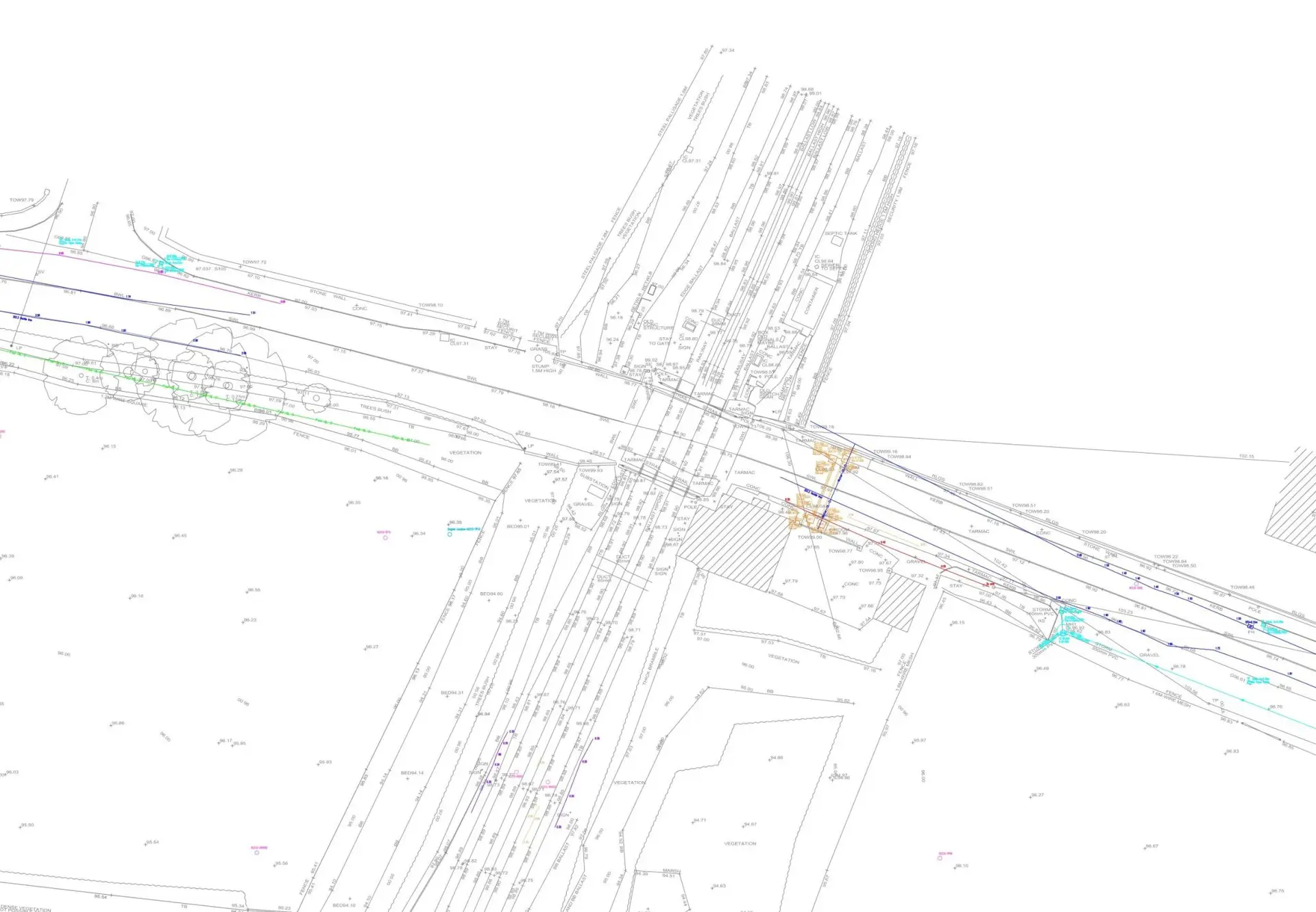
Topographic surveys deliver precise, true‑to‑scale mapping of natural and built environments. By combining terrestrial, mobile, and aerial technologies, we capture detailed site information to support planning, engineering, and construction workflows.
Topographic surveys rely on a combination of terrestrial, mobile, and aerial measurement technologies to accurately capture the physical features and levels of a site. Each technique offers unique advantages depending on the environment, required accuracy, accessibility, and project scale.
We make the surveying process simple, transparent, and stress‑free from start to finish.
Share your project requirements and site details with our team.
We prepare a clear cost estimate and project timeline based on your scope.
Our field specialists attend your site and capture the precise data you need.
Our technical team processes, analyses, and interprets your data to industry standards.
Your completed dataset, reports, and deliverables are reviewed and handed over by our survey managers.
Clear answers to the most common questions about our topographic survey process, accuracy, deliverables, and project requirements.
A topographic survey maps the natural and man‑made features of a site, including levels, boundaries, buildings, utilities, vegetation, and surface features. It is essential for design, planning, engineering, drainage, and construction because it provides an accurate, true‑to‑scale representation of existing site conditions.
Accuracy depends on the techniques used and the project requirements, but our surveys typically achieve high‑precision results using GNSS, total station, terrestrial laser scanning, mobile mapping, and UAV LiDAR/photogrammetry.
All data is quality‑checked and tied to a robust control network to ensure consistency across the entire site.
Timeframes vary depending on site size, complexity, access, and required deliverables.
Small residential sites may take a few hours to survey, while large infrastructure corridors or urban environments may require several days.
Processing and drafting typically follow shortly after fieldwork.
We provide 2D/3D CAD drawings, DTMs, contours, long‑sections, cross‑sections, BIM outputs, orthophotos, point clouds, and PDF reports.
Deliverables can be customised to match your project standards, coordinate systems, or CAD templates.
Yes, drones are used when appropriate, especially for large, open, or difficult‑to‑access areas.
Drone LiDAR and photogrammetry are often combined with terrestrial techniques to ensure complete and accurate coverage.
We typically require:
A site location or boundary map
Access arrangements
Required deliverables (CAD, BIM, DTM, etc.)
Any existing control, benchmarks, or previous surveys
Project timelines and any constraints
This helps us plan the most efficient and accurate survey methodology.
2 Bridge St, Athlone, Co. Westmeath, N37 F1W4
+353 (090) 640 3114
info@utilistics.ie
Mo - Fri : 08:00am - 17:30pm
Sat : 09:00am - 14:00pm