
Drone Surveying in Ireland: What Changing Regulation Means for Projects
An evidence-led look at Irish drone policy, Cork’s geographical-zone consultation, BVLOS and the practical implications for survey procurement and planning.
What does it cost to get started, which training do you need, and where can you actually fly? Work through the Irish registration process, real fee examples and the decisions that make a drone flight lawful and useful.
8 MIN READ · Editorial date 11 June 2026
Reviewed 25 September 2026 · This edition includes later research.
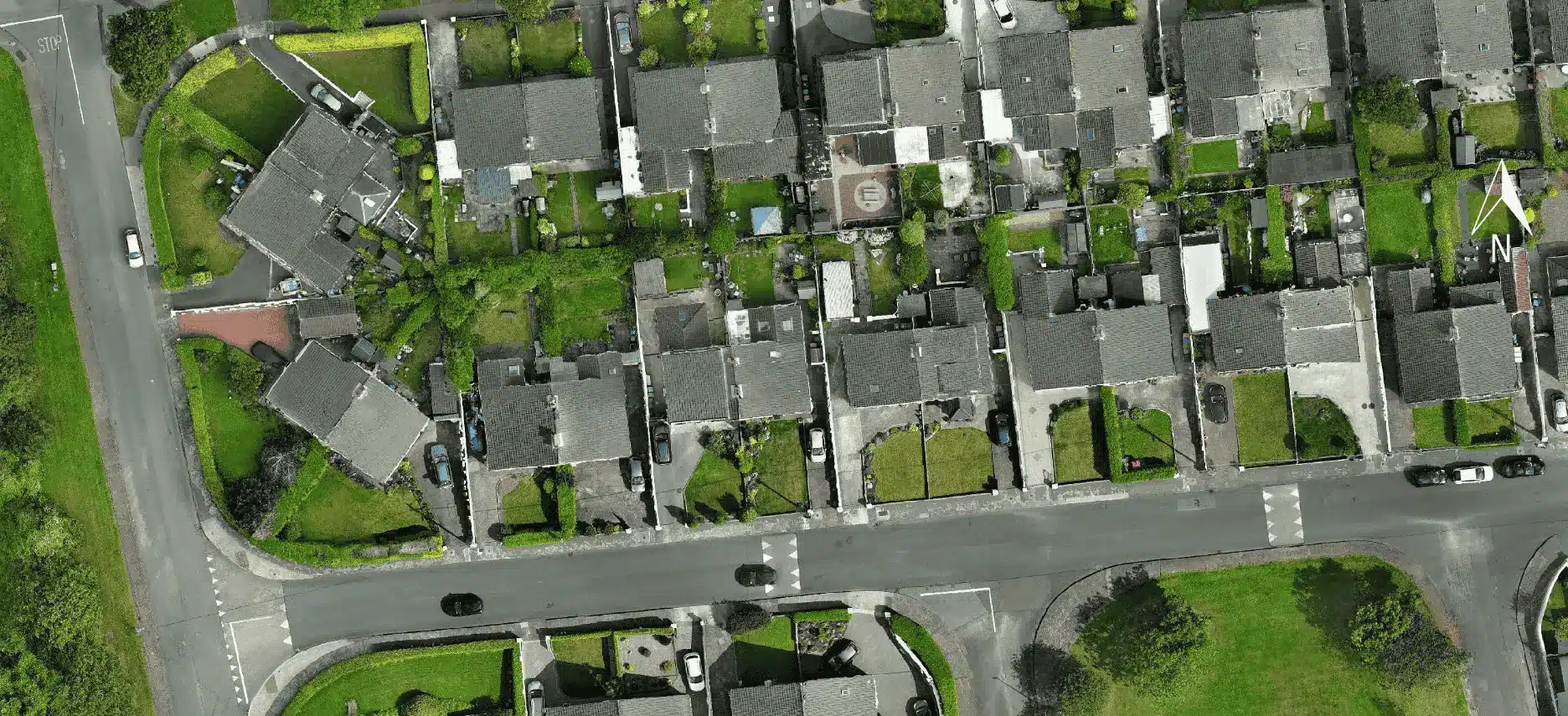
Aerial survey planning starts on the ground.
Choose the operating category from the proposed flight, not whether the job is paid.
Budget separately for operator registration, pilot certificates, training and equipment.
Review current zone conditions and temporary restrictions before every flight.
Begin with a simple flight brief: location, purpose, aircraft, expected height, operating area and the people or property nearby. This makes it much easier to identify the applicable requirements than starting with the question “Which licence do I need?”
The EASA Open category covers low-risk recreational and commercial activity when its conditions are met. “Commercial” is not a separate permission that automatically allows more demanding flights. An operation that does not fit Open needs an appropriate alternative route.
For survey work, discuss the capture area before fixing the programme. A flight line that looks efficient in mapping software may extend beyond the pilot’s visual line of sight or into airspace with additional conditions. The flight plan must fit both the data requirement and the operating permission.
The operator is responsible for the operation; the remote pilot flies the aircraft. They may be the same person. The IAA registration guidance explains the operator account and the use of one registration for multiple aircraft. Registration is not an individual flight approval.
In the Open category, registration is generally required at 250 g or above, and for lighter camera-equipped aircraft that are not toys. Check the full criteria and exemptions for the actual aircraft, including whether a sensor can capture personal data. Do not assume that a small drone is automatically exempt.
Keep registration details current and apply the operator identification and remote-identification requirements relevant to the aircraft and operation.
The IAA’s MySRS registration guide starts with creating an account and verifying your identity. Its introductory online training is free; obtaining the relevant certificate carries a separate charge. If a company operates the aircraft, verify and register the company, while the people who fly hold the appropriate individual pilot credentials. Avoid accidentally treating an employee’s personal operator account as the company’s registration.
Save the operator details and pilot certificates where they can be retrieved on site, and put their expiry dates in the diary. Buying another aircraft does not, by itself, mean creating another operator identity; check how it must be identified and recorded for the intended operation.
The IAA competency guidance sets out the training routes. Small C0 aircraft require familiarity with the manual; other Open operations can require A1/A3 training and examination, with additional requirements for A2. Confirm the route from the aircraft’s class marking and intended use.
For A2, build in the A1/A3 foundation, practical self-training under the required conditions and the additional theoretical assessment. Check the current application instructions before booking a course. An A2 certificate does not upgrade the aircraft’s class or remove the geographical-zone rules.
A certificate is evidence of meeting a defined requirement, not evidence of experience with every survey task. An operator planning mapping work should also consider flight planning, emergency procedures, capture quality, site coordination and the limitations of the payload.
As a client, ask for the evidence relevant to your proposed job. An impressive aircraft specification is not a substitute for the correct operational category, competent personnel and a method that suits the location.
The IAA charges below apply from 1 January 2026 and are VAT exempt. Registration and pilot certificates have different renewal cycles.
Two-year operator registration.
Five-year certificate; online training is free.
Five-year certificate; course charges extra.
Choose the required route first. Paying for additional training can improve confidence, but paying a fee does not give permission for an otherwise unsuitable flight.
The examples below assume a new applicant paying the listed Irish fees, with no existing valid registration or certificates. They are starting calculations for Open operations, not complete equipment or business budgets.
Registration only: an eligible sub-250 g, non-toy camera drone on a route requiring no pilot certificate.
€41 registration + €51 certificate.
€41 registration + €51 A1/A3 + €128 A2. Any provider fee is additional.
For paid A2 preparation, Avtrain advertises €149 for its self-paced online course; it explicitly excludes the IAA certificate issuance fee. Drone Space advertises €400 per person for preparation involving pre-study and lectures, with statutory fees separate. These are two provider examples, not a market average or a like-for-like course comparison.
Those provider prices were checked on 25 September 2026 for this reviewed edition. Neither page states its VAT treatment. Confirm the total payable, assessment arrangements, retest charges and course availability before booking; do not assume the headline price includes every step.
Beyond the paperwork, allow for the aircraft, spare batteries, replacement propellers, charging, travel and appropriate insurance. Survey work may also need planning or processing software, control measurements, storage and time for checking the output. Request itemised quotes against your actual equipment and operation rather than adding an unsupported “typical insurance premium”.
Open operations generally require visual line of sight, a maximum take-off mass below 25 kg and a height within 120 m of the closest point of the earth’s surface, subject to the applicable rules and limited exceptions. A geographical zone can impose a lower limit or other conditions.
A1, A2 and A3 have different conditions around people and locations. C1 flights must not be planned over uninvolved people. For C2 in A2, the standard separation is 30 m, reducible to 5 m under the specified low-speed conditions. A3 requires at least 150 m horizontally from residential, commercial, industrial and recreational areas, as well as protection of uninvolved people.
These summaries are a starting point, not a substitute for checking the aircraft-specific rules. Legacy aircraft, privately built aircraft and class-marked aircraft do not all follow the same route. No Open subcategory permits flight over assemblies of people.
Use the IAA geographical-zone information and read all conditions affecting the site. Zones can overlap. The IAA specifically advises checking published temporary restricted areas, NOTAMs and the current zone data before each flight; its embedded map is marked as reference-only.
A manufacturer’s geofencing display is not the complete legal airspace picture. Likewise, a successful flight at the same location last month does not establish that today’s flight is permitted. Keep the date of the check with the flight record.
Access to take-off and landing areas, environmental restrictions and arrangements with the site occupier are separate practical considerations. For a live construction site, agree how the flight will be coordinated with lifting operations, moving plant and people entering the survey area.
For example, permission from a client to survey a roof does not settle the aviation questions. Check nearby roads, people, neighbouring properties and airspace before accepting the brief. A quiet take-off point can still lead into a flight path that cannot meet the chosen operating conditions.
Confirm the aircraft class and retrieve current operator and pilot documents.
Check that the flight fits the selected category, height and separation limits.
Review overlapping zones, NOTAMs and temporary restrictions; record when you checked.
Agree take-off access, site coordination and the response if someone enters the operating area.
Check weather, batteries, aircraft condition, return-to-home settings and emergency landing options.
The Data Protection Commission’s drone guidance explains how camera use can involve personal data. A camera does not automatically make every activity subject to the same obligations: the purpose, data captured and any applicable exemption matter. Plan collection, access, retention and sharing before capture.
Check insurance requirements for the aircraft, operation and client contract rather than assuming that recreational activity is always exempt or that commercial activity has one universal rule. When requesting a quote, describe the work, aircraft and payload, locations and any required liability limit. Check the excess, exclusions and whether equipment damage and third-party liability are both included where needed.
For work beyond Open, the IAA authorisation guidance explains the available pathways. Some operations require an operational authorisation; eligible standard-scenario operations may use a declaration route. Other privileges or certification requirements can apply. Do not treat “Specific category” as a blanket permission to fly anywhere.
The 2026 fees include €514 for a standard-scenario (STS) declaration, €1,797 for an authorisation using a pre-defined risk assessment (PDRA), and €3,595 for a specific operations risk assessment (SORA) application at assurance levels SAIL I/II. These are alternative routes. Training, documentation, consultancy and airspace-related costs can be additional.
For a one-off survey, compare the full effort of establishing an operation with commissioning an appropriately equipped survey provider. Include planning, weather delays, data processing and quality checks in that comparison. Our view is that the useful measure is the cost of a checked deliverable that supports the project, not simply the cost of getting an aircraft airborne.
Define the flight, confirm the route, then price the paperwork and practical work separately. Keep the official guidance beside the budget: the right certificate, suitable aircraft and a well-planned location must all come together.
Sources checked on 25 September 2026. Current guidance and policy updates belong to this reviewed edition, rather than the earlier assigned editorial date.
Official statutory charges, revision 2026/01.
Account verification, free online training and the separate company-registration process.
Class identification, Open subcategories and operating restrictions.
Irish operator-registration process and guidance.
Training routes depend on the aircraft and intended operation.
€149 advertised when checked on 25 September 2026; IAA issuance fee extra, VAT treatment unstated. Confirm current booking terms.
€400 per person advertised when checked on 25 September 2026; statutory fees separate, VAT treatment unstated. Enquire about availability.
Check the current data, temporary restrictions and NOTAMs before flying; the embedded map is reference-only.
Specific-category authorisation and declaration pathways.
Personal-data considerations and responsibilities for drone operations.


2 Bridge St, Athlone, Co. Westmeath, N37 F1W4
+353 (090) 640 3114
info@utilistics.ie
Mo - Fri : 08:00am - 17:30pm
Sat : 09:00am - 14:00pm