
What Is a Topographic Survey? Scope, Deliverables and Timing Explained
A practical guide to commissioning a topographic survey: features, levels, boundaries, terrain models, deliverables and the factors that influence timing.
Setting out connects a design to a physical location. Getting that connection right depends on current information, reliable control, agreed tolerances and checks made before the work becomes difficult to reverse.
5 MIN READ · Editorial date 21 May 2026
Reviewed 25 September 2026 · This edition includes later research.
Confirm the current design revision, coordinate system and level reference.
Agree tolerances for the actual work rather than relying on a universal number.
Use meaningful independent checks and record decisions before construction proceeds.
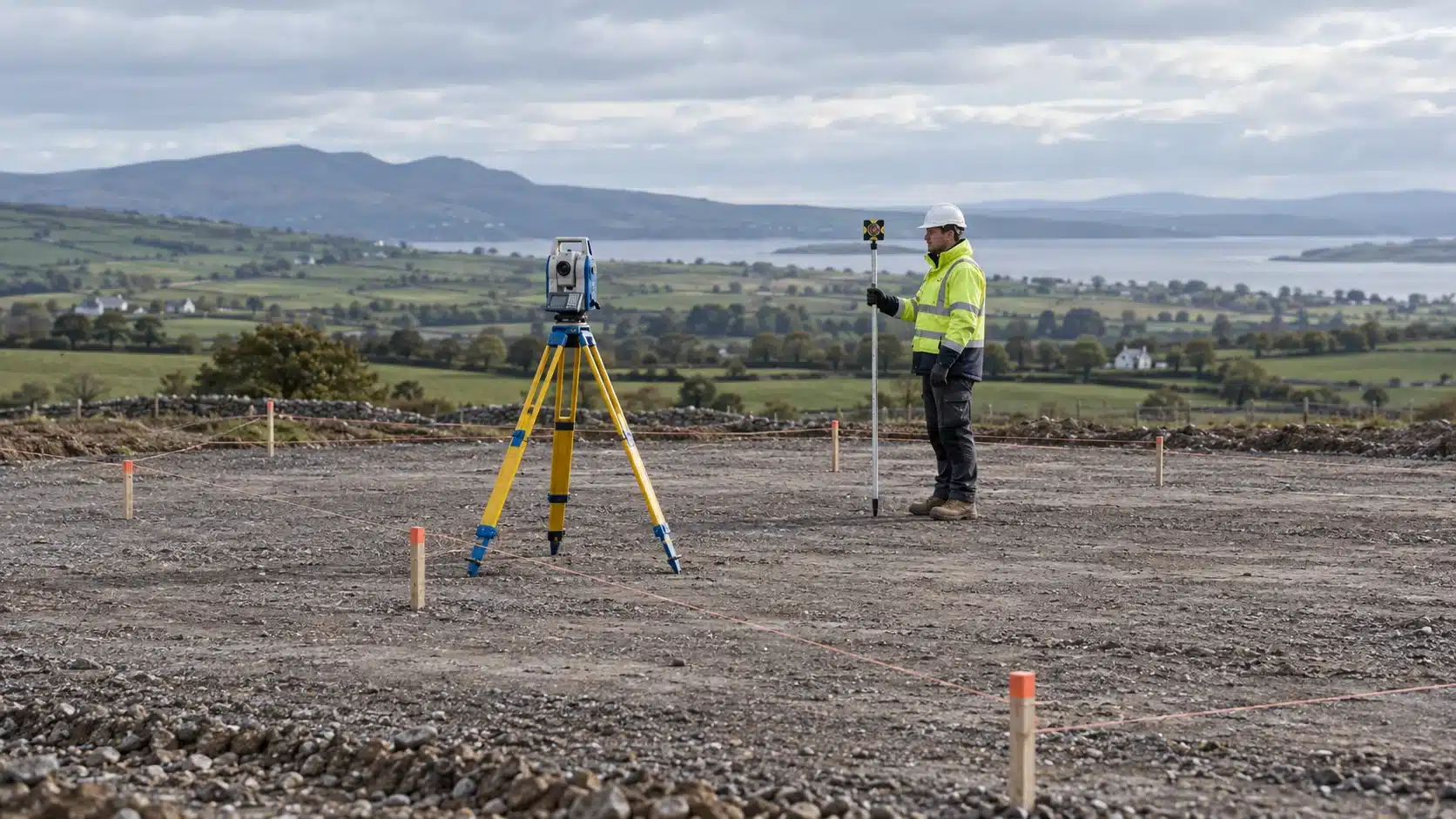
Setting out translates design information into positions, lines and levels on site. The process can involve control stations, gridlines, excavation limits, structural elements, drainage or other works. Its success depends as much on the information supplied as on the instrument used.
Confirm which drawings and models are approved for the activity, their revision and the relationship between them. A superseded drawing can produce accurately measured work in the wrong place. Model coordinates also need to be checked against the project reference rather than assumed to match.
Where dimensions, coordinates and details conflict, raise the discrepancy through the agreed project process. Quietly choosing one interpretation transfers an unresolved design question into construction. A recorded clarification is usually far easier to manage than correcting completed work.
Survey control provides the reference from which work is positioned. Its marks need sensible locations, documented values and protection from disturbance. A point installed beside heavy traffic or active excavation may be convenient today and unreliable tomorrow.
Check control before relying on it and after events that could have affected it. Record damaged or suspect marks so they cannot be reused without review. The availability of several marks is helpful only when their relationship has been properly established and checked.
The same discipline applies to levels. A benchmark needs a clear value and reference, and the team needs to understand whether that reference is local or tied to a wider datum. Similar-looking numbers from different systems can conceal a significant error.
There is no single setting-out tolerance that is suitable for every project element. Requirements depend on the specification, the material, the construction method and the interfaces that must fit together. Agree them before choosing the procedure and acceptance checks.
The scope of ISO 4463-1 includes planning, procedures and acceptance criteria for setting-out. Quoting the standard is not a substitute for identifying the actual project requirements. A general claim that all works are acceptable within one fixed number of millimetres is misleading.
Measurement uncertainty and construction tolerance are also different. The survey method needs sufficient capability to support the intended decision; it should not consume the entire allowance for the finished work. Critical connections may need a more demanding method and an explicit hold point.
Repeating an observation from the same setup with the same wrong input may reproduce the same wrong result. Useful checks challenge the process: the reference used, the orientation, the design interpretation, the coordinate transfer and the physical marks.
The appropriate check depends on the risk and the survey method. It may involve a different control point, a separate dimensional comparison, an independent level check or review by another competent person. The plan should explain what is checked and what result is acceptable.
Consider an illustrative drainage run. A coordinate check alone may confirm plan position while missing an incorrect invert level. A useful check addresses line, level, direction of fall and the connection requirements before the pipe is covered.
Confirm the issue and revision used for setting out.
Verify the control and orientation independently where appropriate.
Check the critical dimensions, levels and interfaces.
Record acceptance or escalate discrepancies before the next activity.
The allocation of responsibility depends on the contracts, appointments, instructions and facts. It should not be reduced to a universal rule that the surveyor, designer or contractor always carries every consequence. Project participants need a shared understanding of their actual obligations.
Agree who supplies the design information, who approves clarifications, who establishes and maintains control, who carries out setting out and who accepts the checks. Also decide who may authorise a change when the site conditions differ from the design.
An inspection or sign-off should have a defined purpose and record. Avoid treating an informal presence on site as approval of every dimension. Clear ownership helps the team resolve an issue promptly without making assumptions about another party’s role.
Protect and identify the marks that the construction team will use. Record offsets and references in a form that remains understandable when the surveyor is no longer standing beside the work. If marks are disturbed, stop relying on them until they are re-established or checked.
Plan the as-built observations around the sequence of work. Buried services, foundations and concealed interfaces are easier to record before they disappear. Waiting until completion can leave the team with photographs and assumptions where measurements were needed.
A useful record identifies what was checked, the reference system, the date and the relevant design revision. It supports handover and gives the next phase a dependable starting point. Setting out and as-built capture work best as connected parts of the same information process.
Reliable setting out combines sound measurements with clear information and timely checks. The most effective moment to resolve a discrepancy is before it is built into the work.
Sources checked on 25 September 2026. Current guidance and policy updates belong to this reviewed edition, rather than the earlier assigned editorial date.
Planning, procedures and acceptance criteria for setting-out. Project requirements still need to be specified.
Professional guidance for specifying measured surveys and their deliverables.

2 Bridge St, Athlone, Co. Westmeath, N37 F1W4
+353 (090) 640 3114
info@utilistics.ie
Mo - Fri : 08:00am - 17:30pm
Sat : 09:00am - 14:00pm